Volume limitation on static FCR-D in the Nordic synchronous area
The Nordic TSOs Svenska kraftnät (Sweden), Statnett (Norway), Fingrid (Finland) and Energinet (Denmark) have jointly initiated an analysis to determine which levels of static FCR-D would be acceptable within the Nordic synchronous area.
Only a certain amount of the total Nordic demand for FCR-D upward and downward regulation can consist of entities providing static FCR-D during the delivery hour.
The reason is to ensure that the provision of FCR-D does not lead to unacceptable risks for operational security or unwanted effects on the frequency when activated. The Nordic TSOs therefore intend to implement a volume limitation on static FCR-D within the Nordic synchronous area.
There is a strong correlation between the acceptable amount of static FCR-D and the levels of inertia in the system, which varies over the year. The correlation can be described as: when levels of inertia are low, the volume of static FCR-D must be limited more, and vice-versa for the opposite case.
Based on the work, the Nordic TSOs intend to implement a volume limitation on static FCR-D, with two components:
- A fixed volume limitation (percentage) on maximum amount of static FCR-D, that is valid all year round
- A variable volume limitation (percentage) that is dependent on the level of inertia in the system and could therefore vary throughout the year
The fixed volume limitation will initially be set at 50% of the total Nordic demand for FCR-D upward regulation. A similar limit will be implemented for FCR-D downward at a later stage.
The variable volume limitation is still to be determined. It will act as an addition to the fixed volume limitation meaning that the total volume limitation on static FCR-D will be lower than or equal to 50%, depending on the level of inertia.
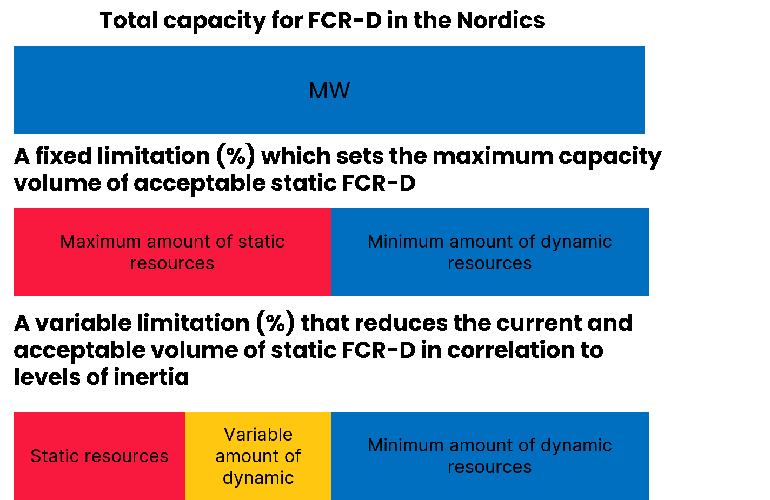
FIGURE 1: MW (100 %)
A fixed limitation (%) which sets the maximum capacity volume of acceptable static FCR-D.
FIGURE 2: Maximum amount of static resources (50 %), Minimum amount of dynamic resources (50 %)
A variable limitation (%) that reduces the current and acceptable volume of static FCR-D in correlation to levels of inertia
FIGURE 3: Static resources, Variable amount of dynamic, Minimum amount fo dynamic resources
Next step
The work regarding the variable volume limitation will continue within the Nordic working group.
After the volume limitations on static FCR-D have been set, the Nordic TSOs will initiate discussions on how to divide the total Nordic volume limitation between each Nordic country. After the national volume limitation on static FCR-D is decided for each country, the national TSO may then implement the limitation on its own national market.
Providers of FCR-D will be informed in advance how and when Svenska kraftnät intends to implement a limitation on static FCR-D.
What is static FCR-D?
Entities that have difficulties to comply with the dynamic requirements, e.g. activation/deactivation performance and dynamic stability can provide a variant of FCR-D called Static FCR-D. The main difference from regular FCR-D (referred to as Dynamic FCR-D) is a grace period of 15 minutes where the entities are not required to deactivate and/or to be able to perform a second activation.
For questions contact fcr@svk.se