Chemical and product management
Svenska kraftnät aims to phase out the use of the most hazardous chemicals and reduce the risks to human health and the environment. It is important to select products that are as good as possible from an environmental and health perspective, and that they are handled correctly. All use of chemicals in Svenska kraftnät operations must be preceded by active product selection.
For further question about chemical management please contact: kemikalier@svk.se
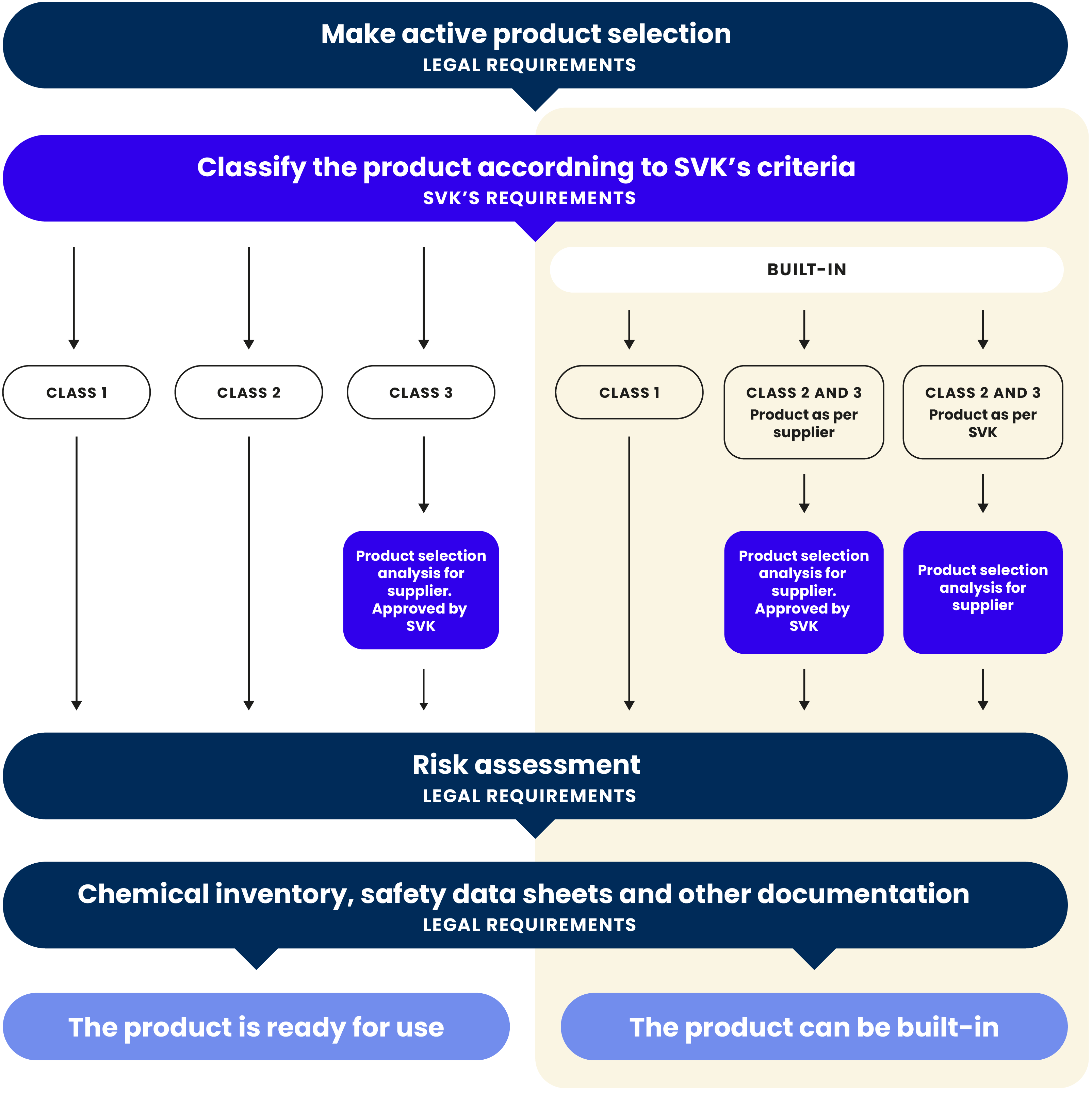
Active product selection must be undertaken in order to increase the use of good products and reduce the quantity of hazardous chemicals. Therefore, for the most part try to use products that have been assessed as set out below, but bear in mind that all products must always be classified in accordance with SVK’s criteria, even if they are selected on the basis of these. See also the section titled Substitution.
- Chemicals that are labelled with “Bra miljöval” (Good Environmental Choice), the Nordic Swan and the EU Ecolabel.
Bra miljöval från Naturskyddsföreningen
Information about the Nordic Swan Ecolabel at svanen.se
The EU Flower, the EU’s ecolabel at EU.se (in English) - Environmental class 1 fuels
- Alkylate-based petrol for four-stroke and two-stroke engines
- Hydraulic fluids/oils compliant with all environmental performance requirements in accordance with Swedish Standard SS 15 54 34
List of chemicals that have been reviewed and approved in accordance with Swedish Standard SS 15 54 34 on the RISE website - Lubricating grease compliant with all environmental performance requirements in accordance with Swedish Standard SS 15 54 70
List of chemicals that have been reviewed and approved in accordance with Swedish Standard SS 15 54 70 on the RISE website - Not subject to labelling requirements and A - Permitted at TRV
- ALPHA-classified products in the BASTA system
All chemical products must be classified before they are used for the assignment. The supplier classifies these by checking the chemical product and its constituent substances against the BASTA system’s criteria and, for prohibited products, against the Swedish Work Environment Authority’s substances subject to prohibition or authorisation requirements (groups A and B) and REACH Annex XIV (Authorisation List).
The requirements in respect of the products are more or less extensive depending on the classification and whether or not it is built into a facility; see the section on product choice analysis.
Class 1: Permitted
Products that meet the criteria for the ALPHA level of the BASTA system. In practice, this refers to products that do not contain or restrict phase-out and risk-reducing substances (i.e. contain no or low levels of substances with hazardous properties).
Class 2: Risk reduction
Chemical products that meet the criteria for the BETA level of the BASTA system. This refers to chemical products that restrict phase-out substances (i.e. may contain risk-reducing substances but no or low levels of phase-out substances).
Class 3: Phase-out
Chemical products containing phase-out substances above the BETA level of the BASTA system. These chemicals may only be used when there is no alternative.
Class 4: Prohibited
Use of products that contain any of the substances listed in Annex XIV to the REACH Regulation or substances included in the A and B lists in Annex 6 to AFS 2023:10 is prohibited in accordance with Svenska kraftnät’s criteria.
Also view
- Product choice analysis must be performed by a person with relevant expertise and be approved prior to use as set out below.
Chemical products used by suppliers for assignments:
- Perform product choice analysis for class 3 products.
The product choice analysis must be approved by a project manager or maintenance engineer - Chemical products built into the installation:
Chemical products in appliances or equivalent selected by the supplier
- Perform product choice analysis for class 2 and class 3.
- The product choice analysis must be approved by a technical manager for the device type (or equivalent)
Chemical products in appliances or equivalent designated by SVK
- Request access to product choice analysis performed by SVK for class 2 and 3 products.
- All product choice analyses as described above must be approved by SVK before the product may be used or built in.
For guidance, see Guide to Svenska kraftnät’s chemical requirements for suppliers (.pdf) Opens in a new window and Product choice analysis (.docx) Download.
The purpose of risk assessing chemicals is to identify the risks associated with the current application regarding handling, use, storage and disposal, as well as appropriate measures to reduce risks.
A risk assessment on the basis of applicable legislation in respect of occupational health and safety, safety and environmental requirements must be available for all chemical products handled by the supplier.
These must be made available to the supplier’s employees and must also be provided to the Customer upon request.
Use your own chemical management system for this in the first instance, but the risk assessment can be performed on the basis of the SVK template if no such system is available.
For guidance, see Guide to Svenska kraftnät’s chemical requirements for suppliers (.pdf) Opens in a new window and Risk assessment (.docx) Download.
An object-specific chemicals list must be prepared for the assignment, and kept up to date. The list must be presented at the request of the Customer.
Built-in stand-alone chemical products and chemical products to be supplied to the Customer as spare materials must also be included in the chemicals list.
The chemicals list must include, as a minimum:
Name of product, product type, consumption, classification, information on product choice analysis, training requirements, requirements for medical inspections, location, built-in/stand-alone, date and person responsible.
For chemical products used by the supplier on behalf of SVK, the supplier must hold a current safety data sheet in accordance with (EC) No. 1907/2006 (REACH) in Swedish and the language(s) spoken at the work location.
Safety data sheets in Swedish must be submitted to the Customer for built-in stand-alone chemical products and chemical products needed as spare materials.
The purpose of requiring the supplier to provide safety data sheets for built-in stand-alone chemicals is to ensure that these chemicals are handled correctly. If an injury/accident occurs, for example, or in connection with demolition/disposal.
Use your own chemical management system for documentation in the first instance, but the products/hazards can be listed as set out in the SVK template if no such system is available.
For guidance, read Guide to Svenska kraftnät’s chemical requirements for suppliers (.pdf) Opens in a new window and List of chemicals (.xlsx) Download.
According to legal requirements and the environmental quality objective “A Non-Toxic Environment”, the application of hazardous substances must cease as far as possible. The classification in groups 1–4 provides a good foundation for prioritising efforts to replace hazardous chemicals.
Phase-out products usually contain high levels of phase-out substances. These substances are, or will be, on the REACH Authorisation List (Annex XIV) and are then prohibited according to SVK’s criteria. Risk reduction substances also have properties which should be noted due to their hazardous nature.
Information about chemicals’ constituent substances and various technical solutions is required so that possible alternatives can be identified and assessed.
Often, a good starting point is to contact the supplier of a particular product to obtain alternatives. Substitution involves removing or replacing chemicals with less hazardous alternatives; more information about this is provided by the Swedish Chemicals Agency. Further guidance and support is available from the Swedish Centre for Chemical Substitution.